StockMags Investing School: Build a research process that helps you understand what you own.
A business can report rising profits while requiring more and more money to produce them. Before calling that progress, ask: What return is management earning on the capital it uses?
Five ways management can use capital
Management can reinvest in operations, acquire other businesses, reduce debt or build cash reserves, pay dividends, or repurchase shares. Each choice has a price and an opportunity cost. A buyback at an excessive valuation can waste money; an acquisition can increase revenue while delivering disappointing returns.
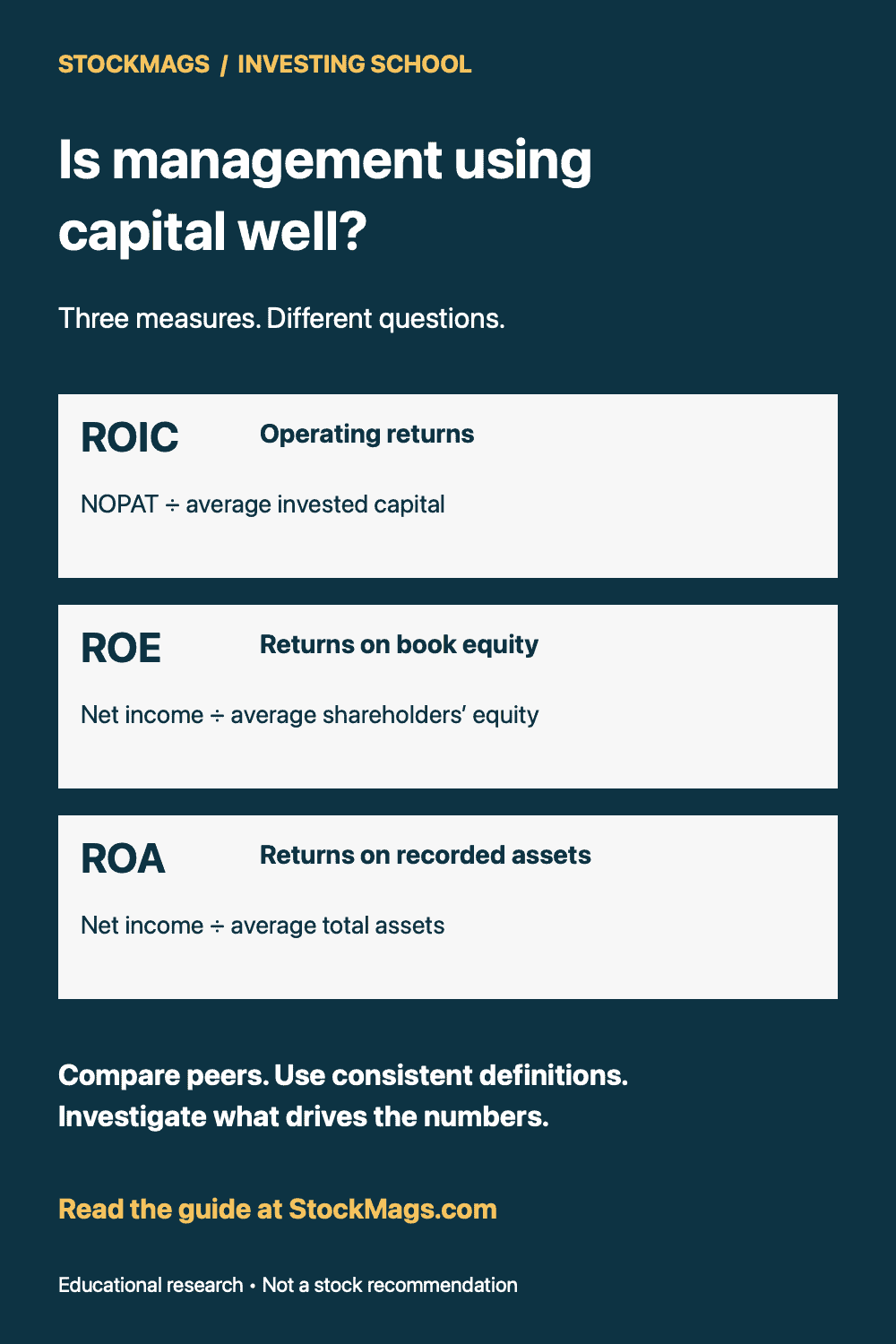
Three measures to understand
1. Return on invested capital (ROIC)
ROIC = net operating profit after tax (NOPAT) ÷ average invested capital.
A common starting approximation for NOPAT is operating income × (1 − tax rate). It measures operating earnings after tax, excluding financing effects such as interest expense. Detailed analysis may require adjustments.
Invested capital represents capital committed to operations. A common financing approach starts with interest-bearing debt plus shareholders’ equity, then subtracts excess cash and other nonoperating assets. Definitions vary, so compare consistently calculated figures.
Illustrative example: A business earns $15 million in NOPAT using $100 million of average invested capital. Its ROIC is 15%. If its estimated weighted average cost of capital (WACC) is 9%, the spread is six percentage points. A sustained positive spread suggests value creation, although accounting adjustments and the cost-of-capital estimate affect that conclusion.
Historical ROIC is useful, but ask what return the company can earn on its next investment. Past success does not guarantee profitable reinvestment.
2. Return on equity (ROE)
ROE = net income ÷ average shareholders’ equity.
ROE measures profits relative to the book equity supporting the business. Book equity includes retained earnings and accounting adjustments; it is not simply the cash shareholders originally contributed.
A high ROE deserves investigation. Borrowing and share repurchases can shrink the equity base and increase ROE without improving operating performance. When equity is tiny or negative, the ratio may be misleading or unsuitable for comparison.
3. Return on assets (ROA)
Standard ROA = net income ÷ average total assets.
This measures earnings relative to the recorded asset base. It includes assets financed by both debt and equity, but it is not a direct measure of debt safety. Interest expense also affects net income. An operating-return variant using NOPAT should be labeled separately.
For a basic annual calculation, average balance-sheet values can be estimated from beginning- and end-of-year balances. Large acquisitions or other major changes may require more frequent averages.
Your five-minute capital-allocation check
- Compare the company with peers in the same industry using consistent definitions.
- Look at several years of returns, rather than one unusually strong year.
- Check whether debt or a shrinking equity base explains a high ROE.
- Ask whether reinvestment, acquisitions, dividends and buybacks fit the business’s opportunities and financial strength.
- Write one sentence explaining why management’s next dollar of spending should create value.
The cost of skipping this step
If you judge a business only by revenue growth, its dividend yield or a rising share price, you can miss expensive growth, weak acquisitions or buybacks funded with excessive borrowing. You may pay for a growth story without understanding the capital needed to sustain it.
Good business economics and a sensible purchase price both matter. Even an excellent allocator can be an unattractive investment at an excessive valuation.
Before your next stock purchase, add ROIC, ROE and ROA to your research notes—and explain what drives each number. These measures support judgment; they do not replace it.
Explore more StockMags research and investing tools.
Sources and methodology
- Jack Henry: NOPAT ROIC definition and reconciliation—an example of company-specific calculation.
- Corporate Finance Institute: Return on Assets.
- Corporate Finance Institute: Return on Invested Capital.
Educational content. All numerical examples are hypothetical and are not stock recommendations.
