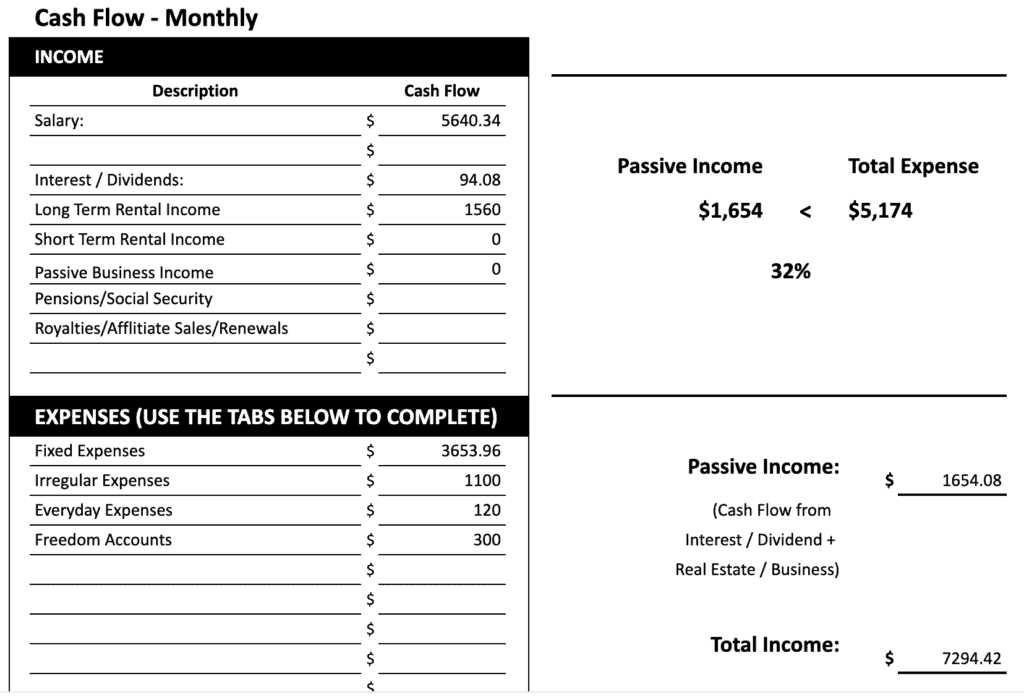
The biggest thing you need to know in order to get out of the Rat Race is to begin tracking your Cash Flow that flows through your financial accounts. What was that? Learn the difference between cashflow and liabilities, then build your own cash flowing businesses via investments. This is easier than you realize once you understand what the real difference between an asset and a liability is. This in itself will retrain your mind to look at everything differently. That house that you live in, no longer is an asset, unless it’s paying you through rental income. What? Seriously, think about it. Does it create you money?
Ok, so now I’m curious as to what the difference is between assets and liabilities because my bank classifies my house as an asset. And the house is an asset for the bank. Why? Because it provides income on the banks income form in the mortgage payment you make to them. But, it is a liability to you unless you are profiting from it, ie renting it out. This alone is one of many items that could be an asset or a liability.
It is time for you to track your assets and liabilities along with your W2 income versus your passive income or personal income from other sources besides your job income. Why? By tracking this income, you will gain a better understanding of how close you are to reaching true financial freedom from your W2 job. This alone is eye opening as to if you are on track or if you need to improve in an area.
Now, we have mentioned the tracker so, here is the link to get it: https://glenncove2020.gumroad.com/l/vnpxq
Incomes Versus Expenses
As you can see with this cash flow tracker you can track positive or negative cash flow and determine what you need to improve your own personal financial planning. By tracking cash flow, you ultimately learn what is producing money for your plans and where you need to improve upon your plans. One of the many ways you can improve your personal income is by learning more about how compounding money works. To start tracking cash flow within your own financial planning you need to know your numbers and just enter them in the tracker. Once you do this, you will have a plan and you will know what you need to do to improve your plan. You will also know if you have made it out of the rat race. Let’s get started with your plan.
Wealth Squad
So, now that you have a tracker to track your W2/Job income versus your Hustle/Passive Income and your expenses. You need to get more ideas of how to increase your Hustle/Passive Income, right? Did you know that you can sale with e-commerce? Or do you want to learn how to set up a dividend account to grow your income? We have the tools. Join our Wealth Squad group of entrepreneurs, millionaires, and future millionaires to learn what works from what does not work. Remember you are a sum average of the people you hang around and talk to. So, now is your time to move into wealth with the rest of us. Join us here: Join The Wealth Squad to Build Wealth Dailyhttps://www.wealthsquad.university/?via=Stockmags
You Don’t Have a Second Income Problem.
You Have a Tracking Problem.
Most income investors already know what to buy. The ones who actually build consistent cash flow are the ones who know exactly what their portfolio is doing — every single day.
“The difference between the investor who builds wealth and the one who merely owns assets is discipline — and discipline begins with knowing your numbers.”
Here’s What Actually Happens to Most Income Investors
You’ve done the research. You’ve bought the holdings — maybe some high-yield ETFs, covered calls funds, dividend payers, or closed-end funds. You have a yield figure somewhere in your head. You told yourself this was going to be your second income stream.
And then… you check your brokerage app. You see a number. You move on. Nothing gets written down. No consistent review happens. And the decisions you make next month are based on whatever you half-remember from looking at a screen a few weeks ago.
That’s not a second income stream. That’s a second income guess.
“Most people say they want a second income stream, but they do not have a repeatable way to track the numbers that matter.”
The painful truth: you can own every right ticker in the world and still make consistently poor decisions — because decisions made from memory are decisions made with noise.
You forget where your NAV was last week. You can’t remember if you’re using more margin than you planned. You eyeball an income estimate instead of calculating it. You see a dip and react emotionally because you have no written guardrails telling you what you actually said you’d do before this moment arrived.
Sound familiar?
- You check your brokerage, see a yield number, and feel vaguely okay — but can’t recall what last month’s income actually was
- You’ve added positions without a clear record of what tier they belong to or why they’re there
- Your watchlist lives in your head (or worse, in a disorganized notes app) and never gets reviewed systematically
- You have margin exposure but don’t track the estimated cost against your income estimate
- Your “weekly review” is a vague intention, not a structured habit with an actual written output
- You make moves you later regret — not because the research was wrong, but because you acted without writing a next step first
None of this is a character flaw. It’s a systems problem. And systems problems have systems solutions.
Treat Your Income Account Like a Business
The Second Income Stream Daily System is a tracking and decision-discipline framework built around one non-negotiable principle:
Write it down. Review the risk. Estimate the income. Write the next action before you act.
That’s it. That’s the whole system. But the execution — the workbook, the calculator, the course, the lesson plans — that’s where the discipline actually lives.
This is not a stock-picking service. It doesn’t tell you what to buy. What it does is give you a clean, repeatable architecture for reviewing what you already own — and making your next decision from data instead of memory.
Record the numbers — every day, every week, every month. NAV, cash position, margin owed, margin cost, income estimates across four time horizons. Before you do anything else in your account, you fill in the workbook. The act of recording is itself a decision filter.
Review your risk guardrails. Before you add any position, before you increase margin, before you touch the watchlist — you check your own rules. The system makes you do this in writing. Not in your head. In writing.
Estimate income across four horizons. Annual. Monthly. Weekly. Daily. These aren’t fantasy projections — they’re calculated estimates from your own data, entered fresh each time. You’ll quickly learn what actually moves your numbers versus what doesn’t.
Write the next action before you act. This is the most underrated part of the system. The investors who blow up portfolios almost always skipped this step. The ones who build sustainable income streams do it every single time.
Everything in the System,
Explained
Second Income Stream Daily System — Full Contents
The fillable spreadsheet and printable worksheets you’ll use every day. Tracks NAV, cash, margin, income estimates, tier holdings, watchlist, and weekly progress.
A structured calculator for estimating annual, monthly, weekly, and daily income from your current holdings — before you make your next move, not after.
A 10-lesson course walking through the philosophy, structure, and use of every element in the system. Self-paced. Designed to be revisited.
For coaches, workshop leaders, and facilitators who want to teach cash-flow tracking. Structured lesson plans built around the course content.
A clear, plain-English guide explaining exactly how to use each section of the workbook — including what each number means and why it matters.
Shows how every lesson, every worksheet section, and every calculator column connect to each other. The map prevents confusion, especially for new users.
Before you open anything else, start here. Sequence the materials, set up your first day, and avoid the most common first-week mistakes.
Everything packaged together. One download, one folder, everything labeled and ready to use on day one.
The Numbers That Actually Drive Your Cash Flow
Most investors track the wrong things obsessively — ticker prices, unrealized gain/loss, portfolio percentage — and ignore the numbers that actually drive their second income story. Here’s what the system is built around:
| Metric Tracked | Why It Matters |
|---|---|
| NAV / Net Account Value | Your single most important number. Tracks trajectory week over week and gives context to every other metric. |
| Available Cash or Withdrawal Amount | How much flexibility you actually have — not what you think you have from memory. |
| Margin Owed & Estimated Cost | If you’re using margin, this forces you to calculate what it’s costing against your income. Most investors skip this. Most investors regret it. |
| Estimated Annual / Monthly / Weekly / Daily Income | Four horizons gives you both the big picture and the daily reality — and prevents the illusion that a big annual yield number means you’re “fine.” |
| Tier 1 / 2 / 3 Holdings | Organizes positions by their role in your strategy — core, supporting, and speculative. Prevents portfolio drift from feeling invisible. |
| Watchlist & Pre-Buy Notes | Ideas go here before they become purchases. Forces a cooling-off period between impulse and action. |
| Weekly Progress Review | A structured weekly lookback that keeps the system honest and builds long-term pattern recognition. |
| Monthly Income Review | The monthly picture closes the loop on your estimates versus what actually hit your account. |
| Risk Guardrails (Pre-Position Check) | Before adding any position — fill this out. If you don’t like your answers, you don’t make the move. Simple. Effective. |
Built for People Who Already Know the What
But Need the How
This is not a beginner’s guide to dividend investing. It assumes you’re already interested in income-producing assets — whether that’s covered call ETFs, high-yield dividend stocks, REITs, closed-end funds, or anything else that distributes cash. What it gives you is the operating infrastructure to manage what you own with the rigor of someone running a small business, not a hobby account.
Tracking dividend or distribution income from ETFs, stocks, REITs, or CEFs who want a daily and weekly review habit.
People who want to build real financial discipline on their own schedule without a course that expires or a coach they can’t afford.
Educators who want to teach cash-flow tracking and need structured lesson plans, materials, and alignment maps ready to go.
Anyone who wants to manage NAV, margin, income estimates, watchlists, and next actions in one clean, repeatable place.
You don’t need a financial background to use this system. You need the willingness to write things down — and to let your own written rules govern your decisions instead of your mood on any given market day.
Why $29.95 Might Be the Cheapest
Risk Management You Ever Buy
Let’s be direct about something: a single impulsive position added without a risk guardrail check — one position — can easily cost you more than $29.95 in a single session. Most income investors can point to at least one decision made from memory or emotion that cost them hundreds, sometimes thousands of dollars.
The Second Income Stream Daily System doesn’t guarantee you’ll avoid those decisions. Nothing can guarantee that. What it does is insert a structured pause — a paper trail — between you and the impulse. You have to fill out the workbook before you act. That friction alone, for many investors, pays for this system many times over in decisions not made.
What you’re buying, at its core, is not a product. You’re buying a professional review process for your own money. The workbook is the infrastructure. The calculator is the discipline enforcement. The course is the philosophy behind why each section exists. The lesson plans are for when you’re ready to share what you’ve learned.
- Stop making decisions from memory — every review starts with the numbers on paper
- Know your estimated income across four time horizons before your next market session
- Track margin exposure against income — not as an afterthought, but as a required first step
- Tier your holdings so your portfolio structure is visible, not just implied
- Keep watchlist ideas in one place before they become impulse buys
- Write your next action before you act — and hold yourself to it
- Build a weekly and monthly review rhythm that compares estimates to reality
- Get a complete, polished system for less than a single dinner out
Stop Guessing. Start Tracking.
Get the Second Income Stream Daily System — workbook, calculator, 10-lesson course, lesson plans, user guide, alignment map, and ZIP package — for a single one-time payment.
Sold via Gumroad · Secure checkout · Digital delivery
Build Wealth Daily While Getting Out Of The Rat Race
So what are you waiting for? Are you like most people, too busy to get wealthy? It might be time to reconsider what is working for you and if you have achieved that goal or not by now. Get your CashFlow Tracker now, make a copy and see where your wealth stands, if it creates cashflow for you, and then get in the Wealth Squad to learn what cash flows and what you need to get wealthy.